

Introduction
One of the most valuable properties of any organization could be the brand itself. It can either be a name, logo, label, slogan or any other combination of these factors that help consumers recognize an organization. But in the absence of proper legal registration, companies run the risk of losing control over their brand name due to possible imitation by rival firms.
Trademark registration in India offers legal protection to the brand by giving exclusive rights to use the brand in connection with the products or services it represents. Though even the rights to the trademark which is not legally registered may be enforced through action for passing off, registration makes its protection easier. Understanding the process of trademark registration is important for entrepreneurs and start-ups.
What Can Be Registered as a Trademark?
According to Section 2(1) (zb) of the Trade Marks Act, 1999, a trade mark refers to any mark which can be depicted graphically and which is able to distinguish the goods or services of one entity from another. A trade mark may consist of:
i. Business names;
ii. Logos/device marks;
iii. Motto/slogans;
iv. Goods packaging/labels;
v. The shapes of goods; and
vi. Any combination of words, letters, numbers or colours.
The key consideration here is that the mark must be distinctive and should not be confusingly similar to other trade-marks.
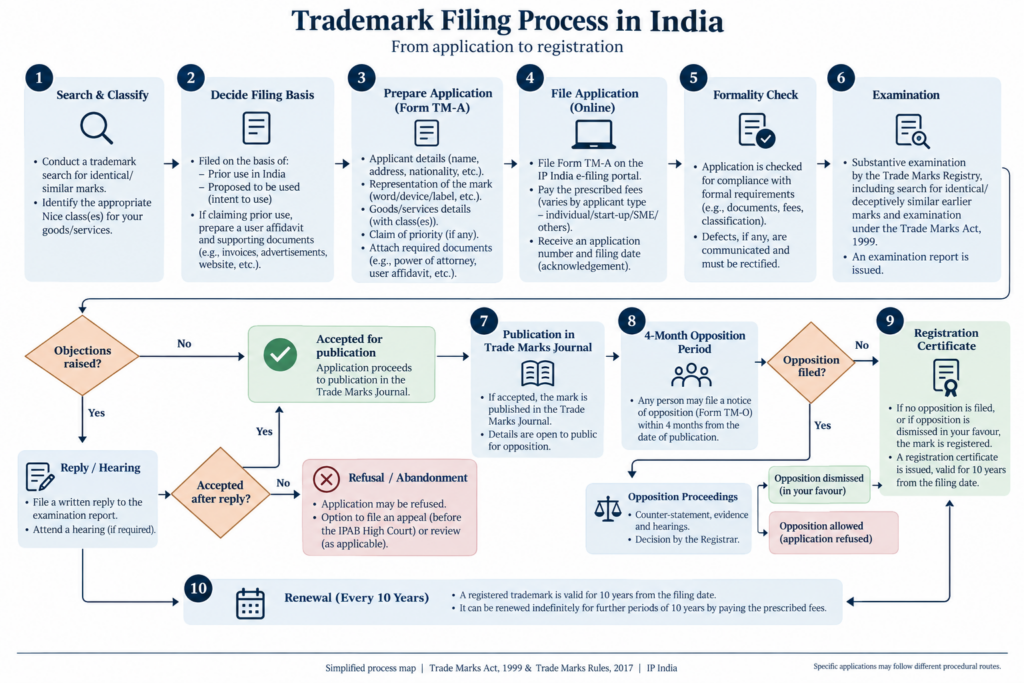
Trademark registration process
Step 1: Perform Trademark Search
Prior to filing an application, a business must undertake a search of the trademark register held by the Trade Marks Registry.
A thorough search would help determine the following:
i. The presence of identical/similar trademarks;
ii. Any grounds of objection likely to arise in the course of examination; and
iii. Dangers of opposition or infringement.
It is common for businesses to devote substantial effort and money towards branding without first confirming if there is no other business using an identical or similar mark. Any dispute over trademarks may result in a business having to rebrand, which could be costly and time- consuming. It is thus crucial that a trademark search is conducted before anything else. A trademark search may be conducted on the Trademarks Public Portal, or you may opt for comprehensive, AI-Powered search tools offered by lawyers for complete analysis of your brand before registration.
Step 2: Determine the Right Classes
The Indian trade mark system relies upon the Nice Classification, which divides goods/services into forty-five categories. The correct choice of class is essential as trademark protection will be extended only for those classes applied for. An incorrect filing class could result in a business being left vulnerable even when the trademark is registered, while generously applying may lead to trademark squatting. There may also be possibilities of certain activities or goods being covered in a different class, and thus it is recommended to seek counsel from a IP lawyer to ascertain all relevant classes.
Step 3: Filing the Trademark Application
Filing of trademark application should be made using Form TM-A before the Registrar of Trade Marks. This work is undertaken by a lawyer, Trademark Attorney or a Trademark Agent. Generally, the application should contain information including name and address of applicant, representative depiction of the trademark, goods/services class and description and other relevant details.
Please note that different government fees applies for individuals and entities that have a MSME Certificate or a Startup Certificate, which is half the rate of the fees charged to any other entity such as companies, partnership firms, LLPs, societies or trusts. On filing, the application will be assigned an application number, and the applicant is free to include “TM” with the trademark.
Step 4: Examination by the Trade Marks Registry
Once the application is filed, it will be examined in terms of sections 9 and 11 of the Trade Marks Act, 1999, where the Registry can raise objections for Absolute Grounds of Refusal (Section 9) or Relative Grounds of Refusal (Section 11).
1. Absolute Grounds for Refusal
Under Section 9, registration may be refused if the mark:
i. Lacks distinctiveness;
ii. Is descriptive of the goods or services;
iii. Has become customary in trade;
iv. Is deceptive or contrary to law or public morality.
2. Relative Grounds for Refusal
Under Section 11, registration may be refused if the mark:
i. Is identical or similar to an earlier trademark; and
ii. Is likely to cause confusion among consumers.
It should be noted that the registrar may either accept and advertise the application or issue an examination report containing objections.
Step 5: Publication in the Trade Marks Journal
Where the Registrar considers the application to be in order, the mark is published in the Trade Marks Journal. The reason behind publication is to give interested persons who think that registration of the mark violates their rights an opportunity to oppose it. Any party can submit a notice of opposition during a period of four months after the date of publication. If there is no opposition within the required time frame, then registration follows.
Step 6: Opposition Proceedings
Opposition proceedings to trademarks are quasi-judicial and could cause significant delays in registration. Grounds for opposition usually include:
i. Earlier use of the same mark;
ii. Probability of deception;
iii. Marke’s lack of distinctiveness; and
iv. Bad faith adoption of the mark.
Step 7: Registration and Granting of Certificate
In case there is no opposition, or if opposition is refused, the Registrar grants the certificate of registration. The effect of registration is that:
i. The trademark becomes an exclusive property of the proprietor;
ii. The registered proprietor can take action against any person who uses the trademark
without authority;
iii. The mark can be denoted with the symbol “®”.
According to Section 25 of the Trade Marks Act, 1999, registration of trademarks will last for ten years at a time.
Practical Issues and Errors in Brand Protection Strategy
1. Selection of Descriptive Marks
It is common practice for a company to choose a name which describes the goods/services. These marks will most likely be objected because they lack
distinctiveness. An invented name/mark is usually better protected under law.
2. The Timing of the Trademark Application
It is very common for companies to wait until their business grows and then apply for trademark protection. By this time, there may be another party that had already
registered a similar mark which leads to litigation. Trademark protection needs to be considered at the initial phase.
3. The Need for International Trademark Protection
Companies planning to expand into international territories must also consider protecting their mark in these countries.
4. Lack of Monitoring Activities
Simply registering a trademark does not suffice. Companies should ensure regular monitoring of the trade journals and the market in order to detect any misuse of the
mark.
Conclusion
Trademark Registration is not simply a process; it is one of the ways of protecting oneself and one’s business interests. Trademark registration is a shield for the brand, adding to its value in both commercial terms and legally defending from infringements. It is crucial to approach the registration process smartly by doing the right search, choosing the right classes and making sure that the mark you want to protect is distinctive enough and legally registrable.